Introduction

What is The New Yorker? I know it’s a great magazine and that it’s a tremendous source of pleasure in my life. But what exactly is it? This blog’s premise is that The New Yorker is a work of art, as worthy of comment and analysis as, say, Keats’s “Ode on a Grecian Urn.” Each week I review one or more aspects of the magazine’s latest issue. I suppose it’s possible to describe and analyze an entire issue, but I prefer to keep my reviews brief, and so I usually focus on just one or two pieces, to explore in each the signature style of its author. A piece by Nick Paumgarten is not like a piece by Jill Lepore, and neither is like a piece by Ian Frazier. One could not mistake Collins for Seabrook, or Bilger for Galchen, or Mogelson for Kolbert. Each has found a style, and it is that style that I respond to as I read, and want to understand and describe.

Showing posts with label Meghan O'Rourke. Show all posts

Friday, January 1, 2016

The Year In Review: 20 Memorable Lines


Here’s one more list – twenty memorable New Yorker lines of 2015:

1. It is the writer who sees everything, hears everything, and reserves the right to fiddle with the aperture. – James Wood, "Look Again" (February 23 & March 2, 2015)

2. “This is about what you leave out, not what you take off. Writing is selection.” – John McPhee, "Omission" (September 14, 2015)

3. “Mayweather’s eyes get bigger when he fights: he seems intensely aware of his own vulnerability, which is precisely what makes him invulnerable.” – Kelefa Sanneh, "The Best Defense" (May 25, 2015)

4. “Dear God, the drinking.” – Anthony Lane, "Good Fights" (January 5, 2015)

5. “ ‘Did he say scallop sperm?’ He did, and it’s mild, sweet, and a little bit wobbly, like custard.” – Amelia Lester, "Tables For Two: Shuko" (August 10, 2015)

6. “After straining for a sterner response to the works, I opted to relax and like them.” – Peter Schjeldahl, "Take Your Time" (January 5, 2015)

7. “This, this: this was the madness of the color line.” – Jill Lepore, "Joe Gould's Teeth" (July 27, 2015)

8. “Tastes differ, and Ishiguro is welcome to his Arthurian chain metal.” – James Wood, "The Uses of Oblivion" (March 23, 2015)

9. “Those who order the pear-and-kale salad, curiously wet, will get what they deserve. – Amelia Lester, "Tables For Two: Brooklyn Bavarian Biergarten" (October 12, 2015)

10. “Riefenstahl might have been both a considerable artist and a considerable Nazis.” – Claudia Roth Pierpont, "Bombshells" (October 19, 2015)

11. “The Wayback Machine is humongous, and getting humongouser” – Jill Lepore, "The Cobweb" (January 26, 2015)

12. “But Walden is less a cornerstone work of environmental literature than the original cabin porn….” – Kathryn Schulz, "Pond Scum" (October 19, 2015)

13. “I don’t like chocolate chips or see the point of vegan cookies.” – Michael Specter, "Freedom From Fries" (November 2, 2015)

14. “No better way to process a paradox than to have another drink.” – Emma Allen, "Bar Tab: Nitehawk Cinema and Lo-Res" (September 21, 2015)

15. “But how deep can a truth be – indeed, how true can it be – if it is not built from facts?” – Kathryn Schulz, "Pond Scum" (October 19, 2015)

16. “Through their decades of vicissitudes, he referred to their marriage as ‘cloudless’—even to his mistress.” – Judith Thurman, "Silent Partner" (November 16, 2015)

17. “Mass violence was buried in the city like strata in rock.” – Raffi Khatchadourian, "A Century of Silence" (January 5, 2015)

18. “Chances are that if you use the Oxford comma you brush the crumbs off your shirtfront before going out.” – Mary Norris, "Holy Writ" (February 23 & March 2, 2015)

19. “You could tattoo the entirety of Max’s dialogue onto his biceps.” – Anthony Lane, "High Gear" (May 25, 2015)

20. “Her spirit vibrates in the greenhouse air. But it can’t make you forget that, for twenty-two bucks at the gift shop, you can become the owner of a Frida oven mitt.” – Peter Schjeldahl, "Native Soil" (May 25, 2015)

Before I conclude, I’d like to give a special shout-out to the writers of “Tables For Two” and “Bar Tab.” These columns are tremendous sources of pleasure. I devour them.

And I want to salute David Denby. His distinguished run as New Yorker movie critic ended this year. I’ll miss his zingers (e.g., “Tarantino has become an embarrassment: his virtuosity as a maker of images has been overwhelmed by his inanity as an idiot de la cinémathèque”). And I’ll miss his superb descriptive analyses – this one, for example, from his memorable "Influencing People" (October 4, 2010), a review of David Fincher’s The Social Network:

The scenes of the Winklevosses in their boat, crisply cutting through the water, are ineffably beautiful; the twins are at ease in their bodies and in nature, while the Zuckerberg gang slouch over their computers in the kind of trashed rooms that Fincher’s anarchists and killers live in. The revolution brews amid garbage.

That’s it! Time to clear the decks and make room for next year’s batch. Thank you New Yorker for another wonderful, absorbing, pleasurable, “unimpeachably interesting” (words stolen from Hannah Goldfield’s delectable "Tables For Two: Lupulo") year of reading. I don’t know how you do it, but you do. I love you.

But wait! I forgot to mention the Best Short Story: Martin Amis’s "Oktober" (December 7, 2015)

Best Poem: Meghan O’Rourke’s "Unforced Error" (October 26, 2015)

Best Cover: Mark Ulriksen’s “Streetball” (September 28, 2015)


I could go on. But I won’t. I’m going to mix myself a drink. If I had the ingredients, I’d try a Negligence (“Appropriately, first on the list is the terrific Negligence, which blends gin, basil syrup, lemon, and absinthe into what looks like a green juice cleanse, but is much better for you, depending on who you trust” – Colin Stokes, "Bar Tab: Threes Brewing," June 29, 2015), but I’m fresh out of basil syrup, damn it. My old standby, the Dark and Dirty (dark rum and Coke), will have to do. Here’s to you, New Yorker, you gorgeous creature. You take my breath away.

Sunday, November 1, 2015

October 26, 2015 Issue


Notes on this week’s issue:

1. I’m pleased to see André Carrilho back in the magazine after a lengthy absence. His portrait of Jeb Bush for Ryan Lizza’s "What Would Jeb Do?" is an eye-catcher. Carrilho has produced some of the magazine’s most inspired illustrations. See, for example, his portrait of Lady Gaga and Beyoncé, for Sasha Frere-Jones’s "Show Runners" (June 27, 2011) and his depiction of Paul Auster for James Wood’s "Shallow Graves" (November 30, 2009) 

2. Dina Litovsky’s photo illustration for Silvia Killingsworth’s "Tables For Two: Timna" beautifully captures the wonderful kubaneh-filled clay flowerpot that Killingsworth mentions in her delectable piece.

3. What to make of Meghan O’Rourke’s "Unforced Error"? Of this much I’m sure – it’s great, even better than her superb "My Aunts" (The New Yorker, July 20, 2009), one of my all-time favorite poems. “Unforced Error” is more complex than “My Aunts.” Like “My Aunts,” it celebrates life. But in “Unforced Error,” failure to see death in the midst of that life is considered a mistake. The combination of disparate images and thoughts is ravishing: “I made a mistake. Now I have a will. It says when I die / let me live. A white shirt, bare legs, bones beneath. / Numbers on a board. A life can be a lucky streak, / or a dry spell, or a happenstance. / Yellow raspberries in July sun, bitter plums, curtains in wind.” That final line is very fine – a form of still life/nature morte. “Unforced Error” is death-haunted. My take-away: Don’t take life for granted.

4. I strongly disagree with the view expressed in Masha Gessen’s "The Memory Keeper" that “the border between journalism and literature is inviolable.” One of this blog’s main premises is that no such boundary exists, and that fact pieces such as Ian Frazier’s "Blue Bloods," Burkhard Bilger’s "Towheads," Lauren Collins’s "Angle of Vision," William Finnegan’s "Dignity," Raffi Katchadourian’s "Transfiguration," Dexter Filkins’s "Atonement," to name just a few recent examples, are as artful, arresting, and meaningful as any novel or short story.

5. The most absorbing piece in this week’s issue is Nicholas Schmidle’s "Ten Borders," which reconstructs the harrowing, dogged, courageous journey of a Syrian refugee named Ghaith from his hometown of Jdeidet Artouz (“Across the street, a sedan was spewing flames. Body parts littered the road”) to Bar Elias (“Ghaith met the smuggler at a restaurant, and paid him five hundred dollars for the plane ticket and the fake passport”) to Beirut (“The officers discovered Ghaith’s Syrian passport in his backpack and arrested him”) to a Beirut jail (“One day, Ghaith watched, horrified, as a pregnant prisoner fell to the floor, blood pooling around her”), back to Jdeidet Artouz (“He felt imperilled whenever he left the house”), then to Istanbul (“After several days, Turkish smugglers herded Ghaith and the others onto buses”), then to Mersin (“Ghaith hitched a ride to the center of Mersin in the back of a produce truck, among piles of oregano, mint, and parsley”), then to Alanya (“Eventually, they were dropped off late one night at a gas station near Alanya, a tourist town on the Turkish Riviera, two hundred and twenty miles west of Mersin”), then via boat into the Mediterranean (“Water slopped over the gunwales and a gaseous odor filled the cabin”), then back to the Turkish Riviera (“Police officers arrived and stretched crime-scene tape around a swath of the beach”), then to Mersin (“In mid-June, Bilal learned that yet another smuggler from Mersin, known as Abu Omar, was running rubber dinghies from Izmir, on Turkey’s western coast, to Lesbos, a Greek island fifteen miles away”), then to Izmir (“At eight o’clock, Turkish smugglers hustled them onto a bus; along the way, they collected another group of refugees, many of whom had to squat in the aisles”), then via rubber dinghy to Lesbos (“The refugees cut the motor and the raft floated to shore”), then to Moria (“They were dropped off at a refugee center that resembled a prison: high fences, watchtowers, concertina wire”), then on an overnight ferry to Athens (“He and Bahaa stood on the deck, watching the sun set on the terra-cotta roofs of Mytilene, Lesbos’s capital”), then via train to Evzonoi, then by foot to Gevgelija (“The Macedonian police collected Ghaith and his friends in a paddy wagon and took them back to the Greek border”), then, following the railroad tracks, trekking to a village five-stops north of Gevgelija, where he and dozens of other refugees boarded a train going north; then disembarking at the last stop before the Serbian border; then trekking to Preševo; then via bus to Belgrade (“Ghaith took a shower to wash off the mud caked behind his ears”); then via smuggler’s van to Vienna (“Ghaith, Bahaa, and Bilal crouched on the floor, so that they couldn’t be seen through the windows”); then via train to Salzburg; then via taxi to Munich; then via train to Copenhagen, and then to Malmö, crossing into Sweden on the Øresund Bridge. It’s an amazing journey, with many close calls and memorable experiences along the way. Schmidle is to be commended for the skillful, detailed way he’s reported it.

6. I read Leo Robson’s "Delusions of Candor" with interest. James Wood, in his recent Slate interview, mentions Robson as one of the critics he regularly reads. He says Robson is “extremely good on fiction.” “Delusions of Candor” is the first Robson piece I’ve read. It’s a review of two books on Gore Vidal – Jay Parini’s Empire of Self: A Life of Gore Vidal and Michael Menshaw’s Sympathy for the Devil: Four Decades of Friendship with Gore Vidal. Robson describes Vidal’s style as “Olympian detachment, patrician hauteur.” This strikes me as exactly right. I’m not a fan of Vidal’s writing. But I did enjoy Robson’s review, especially his argument that Parini “wants to give us the real Gore, but he keeps on falling for the pose.” I like the way he uses passages from Anais Nin’s diary describing Vidal as “lonely,” “hypersensitive,” “insecure,” contrasting her view with the image of the “strapping, self-assured, untouchable Vidal” that Parini presents in his book. Argument, for me, is a key element of a stimulating book review. Robson appears adept at it. I enjoyed his “Delusions of Candor” immensely.

Wednesday, August 28, 2013

August 26, 2013 Issue


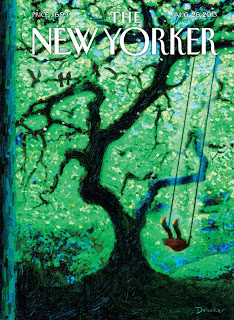
Of the many pleasures of this week’s New Yorker – Christian Felber’s photograph of my favorite jazz singer, Cécile McLorin Salvant; Shauna Lyon’s description of The Elm’s petits fours (“crazy-good smoky chocolate-chip blondies”); Simone Massoni’s delightful, frilly, concentrated, high-kicking “On The Horizon” illustration for Jean Renoir’s French Cancan; David Remnick’s brilliant use of a journal-entry-style sentence (“Early on a summer morning in the Jordanian desert, driving along an empty road toward the Syrian border”), to open his excellent “City of the Lost”; Ken Auletta’s witty “Bloomberg thinks of himself as a team player, as long as it’s his team,” in his absorbing “After Bloomberg”; the gorgeous, vital ending of Meghan O’Rourke’s memorable “What’s Wrong With Me?” (“And I remember being so lost in the sun and the dog’s joy and my pleasure in these hours of freedom that I had no sense that I lived in a body, except as a thing that could feel the sun and the wind and the dog’s cold nose”) – the most piquant is Ian Frazier’s superb Talk story, “By the Numbers,” about a New York City urban garden study. I love the way this piece unfolds - nine deft paragraphs, each a marvel of compressed specificity (like a Bruegel drawing), the whole combining a delightful assortment of details (tattoo of a New York City harbor map, “forty-foot-long telescoping carbon-graphite pole,” striped T-shirt, blue watering can, garlic, devil’s trumpet) and quotes (“From the start, we wanted no spreadsheets, no clipboards, no people standing with clickers at the garden entrances,” “And each garden is different, each has its own creation myth, its own characters,” “There are chickens in urban gardens now!”), sensuously ending with a cucumber crunch. Inspired!

Postscript: Meghan O’Rourke, in her “What’s Wrong with Me?,” mentions three aunts: “At Christmas, I had lunch with three of my mother’s sisters – humorous, unself-pitying Irish-American women in their fifties – at my grandmother’s condo on the Jersey Shore.” Reading this, I think, Hey, I believe I’ve met these remarkable women before. Aren’t they the ones with red nails who are “always laughing and doing their hair up pretty / sharing lipstick and shoes and new juice diets,” and who did “jackknives off the diving board / after school” in O’Rourke’s wonderful poem “My Aunts” [The New Yorker, July 20, 2009]? I believe they are. It’s great to meet them again. They appear to be in good spirits, even though at least two of them suffer painful afflictions. O’Rourke mirrors off their “humorous, unself-pitying” attitude. In “What’s Wrong with Me?,” she writes, “I thought about my aunts, and the matter-of-fact way they lived with their illnesses – as something to deal with, but not something to fuss over. In order to become well, I would have to temper my own fanatical pursuit of wellness.”

Tuesday, July 20, 2010

July 12 & 19, 2010 Issue


I’ve spent the last couple of days in the stimulating company of Meghan O’Rourke’s writings. She has an interesting piece (“The Unfolding”) in this week’s issue. After I read it, I decided to go back and look at two other items by her that appeared recently in the magazine, namely, her great poem “My Aunts” (April 20, 2009), and her critical piece “Good Grief” (February 1, 2010). O’Rourke is preoccupied with death. She says in “Good Grief” that when her mother died she felt “abandoned, adrift.” “Good Grief” is not directly about O’Rourke’s loss of her mother; it’s an analytical piece about ways of grieving. It looks at Elisabeth Kubler-Ross’s “stage theory” and finds that it is largely a fiction. O’Rourke views grief and mourning as “complicated and untidy processes.” Of course, she’s right. How could it be otherwise? Grief is a messy emotion. What I find interesting is that O’Rourke doesn’t delve into the messiness; she stays at a fairly abstract level in this piece. Similarly, in “The Unfolding,” she appears accepting of the oblique approach that Anne Carson employs in her memory book Nox to capture the feelings she experiences flowing from the loss of her brother. “The Unfolding” is a beautifully crafted review of Carson’s Nox. Nox is an unusual book, to say the least. O’Rourke describes it as being “as much an artifact as a piece of writing.” She says, “The contents arrive not between two covers but in a box about the size of the New Revised Standard Version of the Bible. Inside is an accordion-style, full-color reproduction of the notebook, which incorporates pasted-in photographs, poems, collages, paintings, and a letter Michael once wrote home, along with fragments typed by Carson.” Nox appears to be more like an assemblage than a book. The premise on which Nox seems to rest is that “Michael hides in these images, and the point is that all the words and analytical exercise in the world can’t rescue him.” My response to this is: of course, Michael can’t be “rescued”; but through painstaking description and analysis, could he not be made more specific? In Daniel Mendelsohn’s The Lost, which I am currently (slowly) making my way through, Mendelsohn visits Auschwitz. He finds the concentration camp too much of a “symbol.” He says, “I thought, as I walked its strangely peaceful and manicured grounds … [that] it had been to rescue my relatives from generalities, symbols, abbreviations, to restore them to their particularity and distinctiveness, that I had come on this strange and arduous trip.” Nowhere in O’Rourke’s review of Nox does she quote a description of Michael. She says Carson provides affecting details, “but she doles them out sparingly.” In O’Rourke’s most telling observation, she says, “The photos, the fragments of letters, the scraps of translated language enable her to ‘show the truth by allowing it to be seen hiding.’” But surely there is a better way to make use of these fragments? O’Rourke calls her piece “The Unfolding,” and I’m sure this refers, at least in part, to the act of opening up the “accordion” notebook inside the Nox box, but it could also describe memory’s sudden unfolding when it is triggered by an encounter with these scrapbook traces. O’Rourke doesn’t say whether Carson uses the traces of Michael contained in Nox as aide-memoire, but I suspect Carson doesn’t use them in this way. She doesn’t want to. O’Rourke quotes Carson as trying to convey “a certain fundamental opacity of human being.” I’m surprised that O’Rourke isn’t more critical of Carson’s opaque, metaphysical approach to writing about loss. Certainly, O’Rourke herself is not inclined this way, at least not in her delightful poem “My Aunts,” which when it came out in The New Yorker last year, I immediately identified as a keeper, clipped it from the magazine and put it in a folder of my favorite New Yorker poems. “My Aunts” is O’Rourke’s attempt to rescue her aging flamboyant aunts (how many is not clear; at least three, I think) from their mortality by representing them in such vivid, bright word imagery that they might live forever, at least in the form of this poem. It’s a breathless twenty-line sprint of exquisitely noticed (and remembered), crazy, funny details: “doing jackknives off the diving board after school”; “They used to smoke in their cars, rolling the windows down and letting their red nails hang out.” It ends in awareness of the aunts’ vitality imperiled by death: “Stop now, before the green comes to cover up your tall brown bodies.” Vitality and mortality, life and loss – these are O’Rourke’s dual themes. As in the midst of life we are in death, so, in “My Aunts,” in the presence of vitality, we feel its ephemeralness.