Showing posts with label John Colapinto. Show all posts
Saturday, September 15, 2012
September 10, 2012 Issue
There are four remarkable pieces in this week’s issue: John
Seabrook’s “The Geek of Chic”; John Colapinto’s “Check, Please”; Aleksandar
Hemon’s “Beyond the Matrix”; and Ian Parker’s “High Rise.” All four, I’m
pleased to note, are written subjectively. The most subjective and, in many
ways, the most exhilarating is Seabrook’s “The Geek of Chic.” It’s about
Frederico Marchetti and his e-commerce fashion company, the Yoox Group. It
reads like a journal (“In June, I was sitting next to him in the front row of the
Jil Sander menswear show in Milan,” “I did some shopping on Yoox, and saw nice
suits at great prices, but I needed to feel the fabric, and online shopping
can’t provide that,” “It was Yoox’s twelfth birthday – June 20, 2012 – and
Marchetti and I were in Florence,” “During my visit to corporate headquarters,
I met the keeper of Yoox’s algorithm, Alberto Grignolo, a husky, balding man
with pale eyes and a large, smiling face”). I devoured it. “The Geek of Chic”
is a model piece of journalism. But it’s not this week’s Pick of the Issue.
That honor goes to Parker’s brilliant “High Rise.” It’s not as gloriously
subjective as Seabrook’s piece, but that’s okay because it has something else
going for it that’s pure journalistic gold – an irresistibly fascinating leading
character. “High Rise” is a profile of the Danish architect Bjarke Ingels.
Describing this amazing, youthful wizard of energy, wit, creativity and
confidence, attempting to get him down on paper, Parker generates some
inspired, almost surrealistic word combinations. For example: “For the 2010
promotional film, he rode down the bike path running through the heart of his
beautiful, double-looped Danish Pavilion for the Shanghai World Expo, to a
soundtrack of ‘I Gotta Feeling,’ by the Black-Eyed Peas.” When was the last
time you saw “promotional film,” “bike path,” double-looped,” “Danish
Pavilion,” “Shanghai World Expo,” “soundtrack,” and “Black-Eyed Peas” strung
together? Answer: never - it's an original. “High Rise” contains many such
creations. There’s a passage in it illustrating Ingels’s comparison of
designing a building to a joke that’s absolutely extraordinary. I believe this
is the first piece by Parker that’s caused me to sit up and take notice of his
work. I’ll certainly be on the watch for it from now on.
Sunday, January 9, 2011
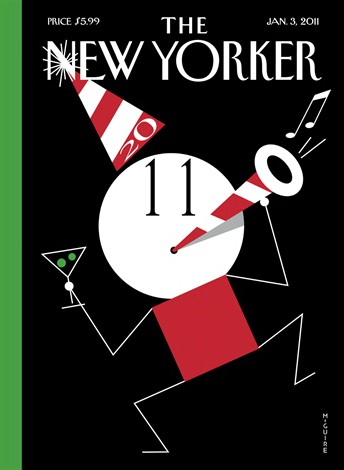
January 3, 2011 Issue

If you delight, as I do, in surprising word combinations verging on the surreal (e.g., “falling chocolate trunk filled with frozen chocolate powder, on a forest floor of lime-and-mint yogurt, with almond praline, puffed quinoa, and green-pistachio streusel”), you will devour Adam Gopnik’s “Sweet Revolution,” in this week’s issue. Gopnik’s charming, sensuous piece begins and ends with soufflé. In between, it takes us to some exotic restaurants in Barcelona, and immerses us in table talk (“This opened us up to the whole question of tiramisù – opened an incredible world to us”) that’s almost as surreal as the avant-garde desserts it describes. Sitting next to the woodstove, looking out at the thickly falling snow, I soaked this piece up the way trifle sponge cake absorbs cognac, and I hungered for more. What a great way to start the year! And it’s proof, at long last, that Gopnik hasn't lost his wonderfully light touch.
Second Thoughts: I’ve decided to revisit this post because I feel I’ve failed to do justice to two other excellent pieces in the January 3rd issue. The two items I’m referring to are John Colapinto’s “Just Have Less” and Jeffrey Toobin’s “Casualties of Justice.” I just want to briefly say that I enjoyed the Colapinto piece immensely, particularly the description of the weaving technique called intrecciato. Regarding the disturbing “Casualties of Justice,” I was impressed by the way Toobin constructed his narrative from myriad interviews and transcripts. The narrative slant against Marsh (“Marsh and his colleagues took an important but fairly routine political corruption investigation in Alaska and tried to leverage it into a prosecution of one of the leading political figures in the country. In doing so, they failed themselves and the Justice Department”) that emerges late in the piece seems at odds with the story’s tagline (“The Justice Department clearly wronged Senator Ted Stevens. Did it also wrong one of his prosecution?”). Toobin appears to answer the tag’s question in the negative on the basis of little more than that Marsh was part of the legal team that botched Stevens’s prosecution. The article leaves me wondering what exactly Marsh did that constituted misconduct.
Labels:
Adam Gopnik,
Jeffrey Toobin,
John Colapinto,
The New Yorker
Subscribe to:
Posts (Atom)
